> ## Documentation Index
> Fetch the complete documentation index at: https://docs.chronicle-labs.com/llms.txt
> Use this file to discover all available pages before exploring further.
# Twins
> Find a twin's URL and token, call it like the real service, and read back what happened.
A twin is a running copy of one service. It has a `base_url`, a `token`, and a
`status`. Worldsmith creates one per service in a world; you can also create a
standalone twin.
Use a [configured SDK client](/api-reference/languages/overview#use-the-guide-examples).
The examples share that client and the IDs returned by earlier steps.
## Methods
| Method | HTTP | Does |
| ---------------------------------------------- | --------------------------------- | ---------------------------------- |
| `twins.models()` | `GET /v1/twins/models` | List supported services. |
| `twins.list()` | `GET /v1/twins` | List your twins. |
| `twins.create(service, ...)` | `POST /v1/twins` | Create a standalone twin. |
| `twins.retrieve(twin_id)` | `GET /v1/twins/{twinId}` | Read one twin. |
| `twins.wait(twin_id)` | polls the above | Block until `running` or `failed`. |
| `twins.reset(twin_id)` | `POST /v1/twins/{twinId}/reset` | Restore the original seed. |
| `twins.stop(twin_id)` | `DELETE /v1/twins/{twinId}` | Stop it. |
| `twins.activity.list(twin_id)` | `GET /v1/twins/{twinId}/activity` | Request history. |
| `twins.activity.retrieve(twin_id, request_id)` | `GET .../activity/{requestId}` | One request in full. |
## Connect an agent to a twin
Use the world ID returned by [Worlds](/api-reference/worldsmith). Read the world,
pick the twin, and configure your existing vendor client with its URL and token.
The vendor paths are unchanged: Slack under `/api/`, Linear at `/graphql`,
Salesforce under `/services/data/`, SAP under `/sap/opu/odata/`.
```python Python theme={null}
world = client.worlds.retrieve(world_id)
slack = next((t for t in world.twins if t.service == "slack"), None)
if slack is None or slack.status != "running":
raise RuntimeError("This world has no running Slack twin")
slack_base_url, slack_token = slack.base_url, slack.token
```
```typescript TypeScript theme={null}
const world = await client.worlds.retrieve(worldId);
const slack = world.twins.find((t) => t.service === "slack");
if (!slack || slack.status !== "running") throw new Error("This world has no running Slack twin");
const slackBaseUrl = slack.baseUrl;
const slackToken = slack.token;
```
```javascript JavaScript theme={null}
const world = await client.worlds.retrieve(worldId);
const slack = world.twins.find((t) => t.service === "slack");
if (!slack || slack.status !== "running") throw new Error("This world has no running Slack twin");
const slackBaseUrl = slack.baseUrl;
const slackToken = slack.token;
```
```go Go theme={null}
world, err := client.Worlds.Retrieve(ctx, worldID)
if err != nil { return err }
var slack *chronicle.Twin
for i := range world.Twins {
if world.Twins[i].Service == "slack" { slack = &world.Twins[i]; break }
}
if slack == nil || slack.Status != "running" { return fmt.Errorf("this world has no running Slack twin") }
// Supply slack.BaseURL and slack.Token to your existing Slack client configuration.
```
```rust Rust theme={null}
let world = client.worlds().retrieve(&world_id).await?;
let slack = world.twins.iter().find(|t| t.service == "slack" && t.status == "running")
.ok_or("This world has no running Slack twin")?;
let slack_base_url = &slack.base_url;
let slack_token = &slack.token;
```
Set your Slack client's API base URL to `slack_base_url` and its credential to
`slack_token` (using your language's variable naming). Other services work the
same way: change the endpoint and credential in the existing tool integration,
then use IDs returned by that twin. Do not log the token.
[Explore the connected service records](/product-explorer#connected-records)
to see the issue, order, case, and channel your tools will work with.
In an evaluation you don't do this yourself. Chronicle creates fresh twins
for each trial and passes their URLs and tokens to your agent as environment
variables. See [Connect your agent](/platform/agents).
## Read what happened
Every request to a twin is recorded. The list gives you a summary per request;
the detail gives you the full request, response, and every record that changed
with before and after values.
```python Python theme={null}
page = client.twins.activity.list(slack.id, limit=50)
for a in page.items:
print(a.request_id, a.request.method, a.request.path, a.response.status)
if not page.items:
raise RuntimeError("No requests yet; call the twin through your agent first")
detail = client.twins.activity.retrieve(slack.id, page.items[0].request_id)
for m in detail.mutations:
print(m.collection, m.operation, m.before, m.after)
```
```typescript TypeScript theme={null}
const page = await client.twins.activity.list(slack.id, { limit: 50 });
for (const a of page.items) console.log(a.requestId, a.request.method, a.request.path, a.response.status);
if (!page.items.length) throw new Error("No requests yet; call the twin through your agent first");
const detail = await client.twins.activity.retrieve(slack.id, page.items[0].requestId);
for (const m of detail.mutations) console.log(m.collection, m.operation, m.before, m.after);
```
```javascript JavaScript theme={null}
const page = await client.twins.activity.list(slack.id, { limit: 50 });
for (const a of page.items) console.log(a.requestId, a.request.method, a.request.path, a.response.status);
if (!page.items.length) throw new Error("No requests yet; call the twin through your agent first");
const detail = await client.twins.activity.retrieve(slack.id, page.items[0].requestId);
for (const m of detail.mutations) console.log(m.collection, m.operation, m.before, m.after);
```
```go Go theme={null}
page, err := client.Twins.Activity.List(ctx, slack.ID, chronicle.PageParams{Limit: 50})
if err != nil {
return err
}
for _, a := range page.Items {
fmt.Println(a.RequestID, a.Request.Method, a.Request.Path, a.Response.Status)
}
if len(page.Items) == 0 { return fmt.Errorf("no requests yet; call the twin through your agent first") }
detail, err := client.Twins.Activity.Retrieve(ctx, slack.ID, page.Items[0].RequestID)
if err != nil {
return err
}
for _, m := range detail.Mutations {
fmt.Println(m.Collection, m.Operation, m.Before, m.After)
}
```
```rust Rust theme={null}
let page = client.twins().activity().list(&slack.id, PageParams { limit: Some(50), ..Default::default() }).await?;
for a in &page.items {
println!("{} {} {} {}", a.request_id, a.request.method, a.request.path, a.response.status);
}
let request = page.items.first().ok_or("No requests yet; call the twin through your agent first")?;
let detail = client.twins().activity().retrieve(&slack.id, &request.request_id).await?;
for m in &detail.mutations {
println!("{} {} {:?} {:?}", m.collection, m.operation, m.before, m.after);
}
```
Very large payloads are truncated and flagged with `truncated: true`. For all
twins in a world at once, use `worlds.activity.list(world_id)`.
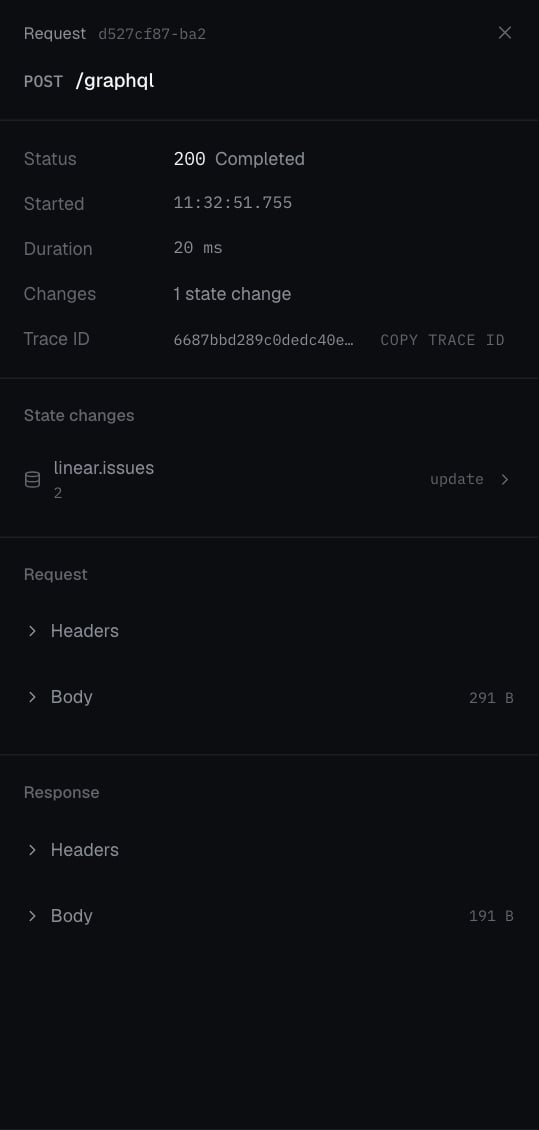 [Open the request image](/images/product/worldsmith-request-focused.png).
## Reset or stop
Choose one action: reset restores the seed; stop ends the runtime.
```python Python theme={null}
client.twins.reset(slack.id) # back to the original seed
# Or shut it down: client.twins.stop(slack.id)
```
```typescript TypeScript theme={null}
await client.twins.reset(slack.id); // back to the original seed
// Or shut it down: await client.twins.stop(slack.id);
```
```javascript JavaScript theme={null}
await client.twins.reset(slack.id); // back to the original seed
// Or shut it down: await client.twins.stop(slack.id);
```
```go Go theme={null}
_, err = client.Twins.Reset(ctx, slack.ID) // back to the original seed
if err != nil { return err }
// To stop instead, call client.Twins.Stop(ctx, slack.ID) and check its error.
```
```rust Rust theme={null}
client.twins().reset(&slack.id).await?; // back to the original seed
// Or shut it down: client.twins().stop(&slack.id).await?;
```
After a reset the twin goes through `provisioning` again; `twins.wait` blocks
until it's `running`, then re-read `base_url` before reconnecting. Twins also
stop on their own when `ttl_hours` runs out.
## Create a standalone twin
For one service on its own, including Gmail, Google Sheets, or ModMed, which
Worldsmith doesn't author:
```python Python theme={null}
twin = client.twins.create(service="slack", ttl_hours=24)
twin = client.twins.wait(twin.id, timeout=180)
if twin.status != "running":
raise RuntimeError(f"Twin {twin.id}: {twin.status}; {twin.error}")
print(twin.id, twin.status)
```
```typescript TypeScript theme={null}
let twin = await client.twins.create({ service: "slack", ttlHours: 24 });
twin = await client.twins.wait(twin.id, { timeout: 180_000 });
if (twin.status !== "running") throw new Error(`Twin ${twin.id}: ${twin.status}; ${twin.error}`);
console.log(twin.id, twin.status);
```
```javascript JavaScript theme={null}
let twin = await client.twins.create({ service: "slack", ttlHours: 24 });
twin = await client.twins.wait(twin.id, { timeout: 180_000 });
if (twin.status !== "running") throw new Error(`Twin ${twin.id}: ${twin.status}; ${twin.error}`);
console.log(twin.id, twin.status);
```
```go Go theme={null}
twin, err := client.Twins.Create(ctx, chronicle.TwinCreateParams{Service: "slack", TTLHours: 24})
if err != nil {
return err
}
twin, err = client.Twins.Wait(ctx, twin.ID)
if err != nil {
return err
}
if twin.Status != "running" { return fmt.Errorf("twin %s: %s; %v", twin.ID, twin.Status, twin.Error) }
fmt.Println(twin.ID, twin.Status)
```
```rust Rust theme={null}
let twin = client.twins().create(TwinCreateParams {
service: "slack".into(),
ttl_hours: Some(24),
..Default::default()
}).await?;
let twin = client.twins().wait(&twin.id, Duration::from_secs(180)).await?;
if twin.status != "running" { return Err(format!("twin {}: {}; {:?}", twin.id, twin.status, twin.error).into()); }
println!("{} {}", twin.id, twin.status);
```
| Parameter | Required | Meaning |
| ------------------------ | -------- | -------------------------------------------------------------------------------- |
| `service` | Yes | A service ID from `twins.models()`. |
| `ttl_hours` | No | Lifetime, 1 to 720. Default 72. |
| `environment_version_id` | No | Seed it from a published environment version instead of the default sample data. |
## Twin status
| Status | Meaning |
| -------------- | ----------------------------------- |
| `provisioning` | Starting up. |
| `running` | Ready. |
| `degraded` | Failed its last health check. |
| `stopped` | Stopped on request. |
| `expired` | Stopped because its lifetime ended. |
| `failed` | Never became usable. See `error`. |
[Open the request image](/images/product/worldsmith-request-focused.png).
## Reset or stop
Choose one action: reset restores the seed; stop ends the runtime.
```python Python theme={null}
client.twins.reset(slack.id) # back to the original seed
# Or shut it down: client.twins.stop(slack.id)
```
```typescript TypeScript theme={null}
await client.twins.reset(slack.id); // back to the original seed
// Or shut it down: await client.twins.stop(slack.id);
```
```javascript JavaScript theme={null}
await client.twins.reset(slack.id); // back to the original seed
// Or shut it down: await client.twins.stop(slack.id);
```
```go Go theme={null}
_, err = client.Twins.Reset(ctx, slack.ID) // back to the original seed
if err != nil { return err }
// To stop instead, call client.Twins.Stop(ctx, slack.ID) and check its error.
```
```rust Rust theme={null}
client.twins().reset(&slack.id).await?; // back to the original seed
// Or shut it down: client.twins().stop(&slack.id).await?;
```
After a reset the twin goes through `provisioning` again; `twins.wait` blocks
until it's `running`, then re-read `base_url` before reconnecting. Twins also
stop on their own when `ttl_hours` runs out.
## Create a standalone twin
For one service on its own, including Gmail, Google Sheets, or ModMed, which
Worldsmith doesn't author:
```python Python theme={null}
twin = client.twins.create(service="slack", ttl_hours=24)
twin = client.twins.wait(twin.id, timeout=180)
if twin.status != "running":
raise RuntimeError(f"Twin {twin.id}: {twin.status}; {twin.error}")
print(twin.id, twin.status)
```
```typescript TypeScript theme={null}
let twin = await client.twins.create({ service: "slack", ttlHours: 24 });
twin = await client.twins.wait(twin.id, { timeout: 180_000 });
if (twin.status !== "running") throw new Error(`Twin ${twin.id}: ${twin.status}; ${twin.error}`);
console.log(twin.id, twin.status);
```
```javascript JavaScript theme={null}
let twin = await client.twins.create({ service: "slack", ttlHours: 24 });
twin = await client.twins.wait(twin.id, { timeout: 180_000 });
if (twin.status !== "running") throw new Error(`Twin ${twin.id}: ${twin.status}; ${twin.error}`);
console.log(twin.id, twin.status);
```
```go Go theme={null}
twin, err := client.Twins.Create(ctx, chronicle.TwinCreateParams{Service: "slack", TTLHours: 24})
if err != nil {
return err
}
twin, err = client.Twins.Wait(ctx, twin.ID)
if err != nil {
return err
}
if twin.Status != "running" { return fmt.Errorf("twin %s: %s; %v", twin.ID, twin.Status, twin.Error) }
fmt.Println(twin.ID, twin.Status)
```
```rust Rust theme={null}
let twin = client.twins().create(TwinCreateParams {
service: "slack".into(),
ttl_hours: Some(24),
..Default::default()
}).await?;
let twin = client.twins().wait(&twin.id, Duration::from_secs(180)).await?;
if twin.status != "running" { return Err(format!("twin {}: {}; {:?}", twin.id, twin.status, twin.error).into()); }
println!("{} {}", twin.id, twin.status);
```
| Parameter | Required | Meaning |
| ------------------------ | -------- | -------------------------------------------------------------------------------- |
| `service` | Yes | A service ID from `twins.models()`. |
| `ttl_hours` | No | Lifetime, 1 to 720. Default 72. |
| `environment_version_id` | No | Seed it from a published environment version instead of the default sample data. |
## Twin status
| Status | Meaning |
| -------------- | ----------------------------------- |
| `provisioning` | Starting up. |
| `running` | Ready. |
| `degraded` | Failed its last health check. |
| `stopped` | Stopped on request. |
| `expired` | Stopped because its lifetime ended. |
| `failed` | Never became usable. See `error`. |