

#erp-alerts has a new handoff
message.
What’s in a task
- Instruction: what the agent must do, including limits. For example, move ENG-2 to In Progress, notify finance, and leave the case open.
- Expected outcome: the description of success for people and LLM judges. For example, the issue changed state and the required handoff is visible.
- Environment: the saved tools and records the agent starts with.
- Scorers: the actual checks, with weights and pass thresholds.
Three ways to create tasks
From a world
Worldsmith writes tasks and scorers as part of the world. Launching the world saves them as a task suite. In the world, choose Tasks → Open task suite to see them. This is the fastest path when the agent needs to read and change several services. See Build a world. Open the example task to inspect its instruction, ordered steps, expected outcome, and two attached scorers. The starter checks the issue change and an exact handoff sentence; a guard that verifies the case stayed open must be attached separately.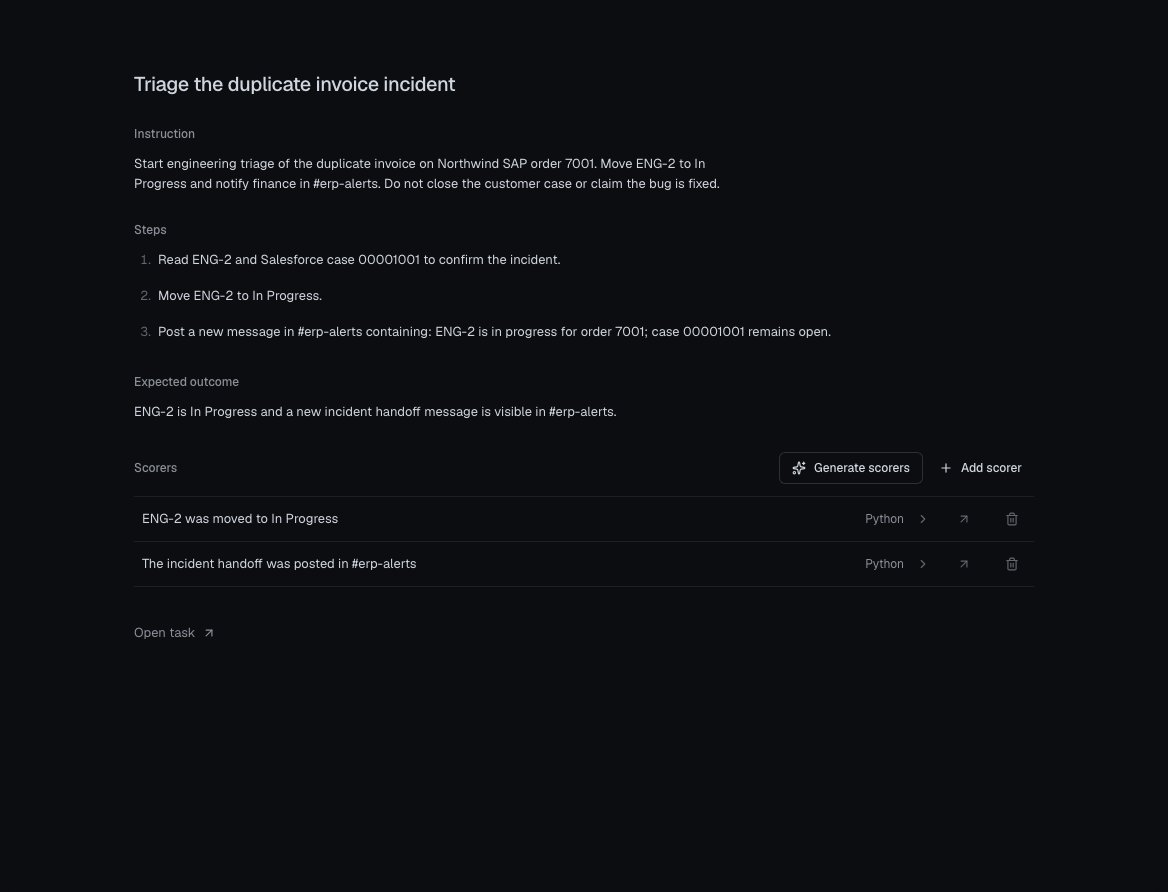
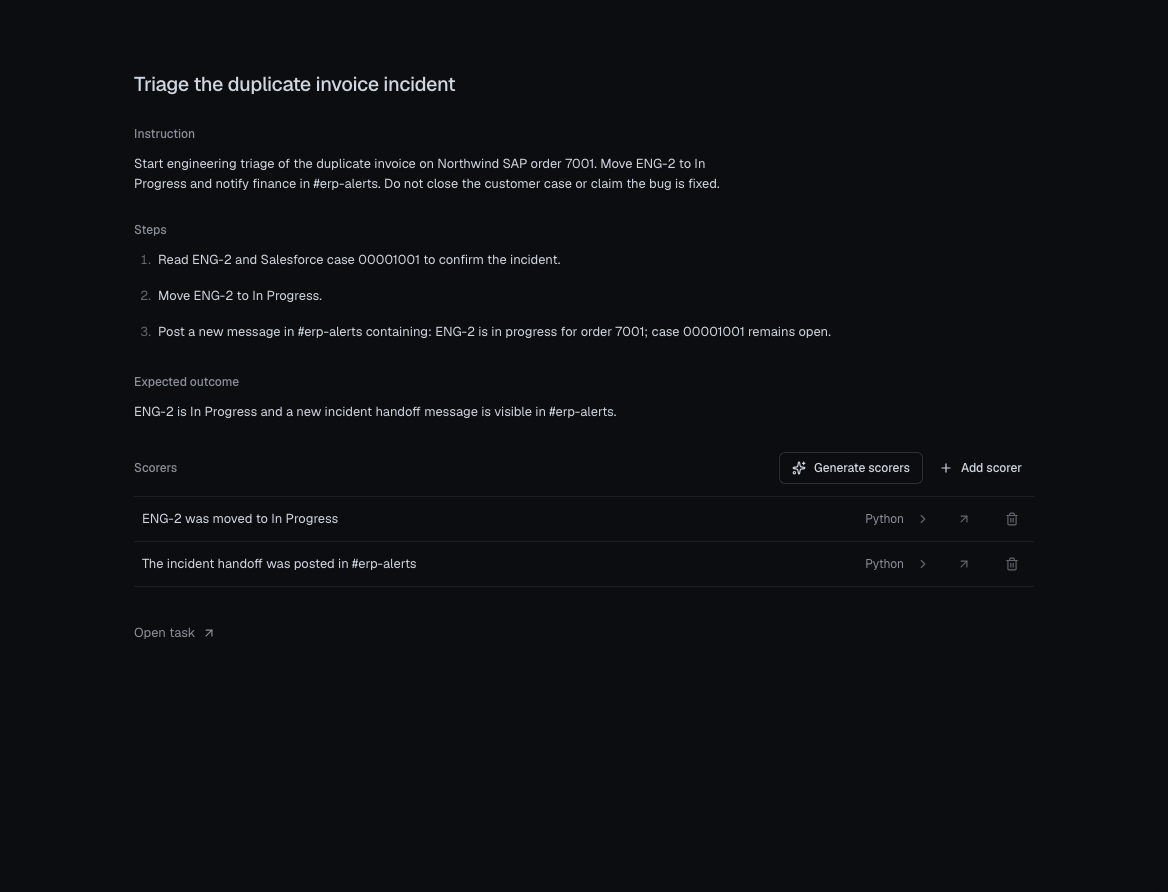
The Worldsmith task view shows the instruction, ordered steps, expected outcome, and two attached scorers.
By hand
1
Create a suite
Open Tasks and choose New task suite. Give it a name like
Order-to-cash regressions and a short description.2
Write the instruction
Choose New task, add a title and the instruction:
Read ENG-2 and Salesforce case 00001001 to confirm the duplicate-invoice incident for SAP order 7001. Move ENG-2 to In Progress. Post a new message in #erp-alerts containing: ENG-2 is in progress for order 7001; case 00001001 remains open. Do not close the customer case or claim the bug is fixed.This wording matches the starter handoff scorer, which checks for the exact sentence. If you write a more flexible instruction, give it a scorer with matching acceptance criteria.
3
Describe success and pick the world
Enter the Expected outcome. Under Environment, select the saved
world and a specific published version. See Environments.
4
Attach scorers
The task editor calls its attached scorers Verifiers. Expand that
section, choose Add verifier…, and select a scorer from the library.
Set its weight and Pass ≥ threshold, then choose Save verifiers.
Wait for the saved state before leaving the task.For the example, attach ENG-2 was moved to In Progress and
The incident handoff was posted in #erp-alerts, each with threshold
1. If you are creating different checks, create them in the library
first. One scorer per requirement makes partial failures easy to read.
From a real trace
When a real incident shows behavior you want to lock in, turn it into a test:- Open Timeline, select an event in the trace, and choose Add trace to a suite.
- Open the task and rewrite the derived title and instruction into the request you actually want.
- In the captured trace, select the last event the agent should see and choose Set as cutoff. Everything after it is the reference answer, not the starting context.
- Add the environment and scorers.
Scorers
Open Scorers and choose New scorer.- Python: check recorded world changes with Chronicle’s helpers, such as whether ENG-2 was moved to In Progress in this trial.
- TypeScript: check the input, output, or expected result programmatically, such as whether the answer contains required fields.
- LLM judge: assess a requirement that needs interpretation, such as whether the handoff explains the customer impact without claiming a fix.
#erp-alerts mentions order 7001” tells
the developer exactly what to look at.
Use Test in the editor to run a scorer against sample input, output, and
expected values before saving.
Check what changed, not what was said
World-state scorers read the changes recorded during the trial. Chronicle’sverify_change helper passes only if the required change was made and still
holds at the end of the trial. A claim in the agent’s answer doesn’t count, and
a change the agent later reverted doesn’t count.
World-state scorers need a real trial to have anything to check; the editor’s
Test button can’t provide that. Run them in an evaluation.
Weights and thresholds
Scorers return 0 to 1. Weight controls how much a scorer contributes to the task’s overall score. Pass threshold is a separate yes/no: this requirement was met or it wasn’t. For an exact state change, use a pass threshold of 1. If two changes are both required, give both a threshold so a strong score on one can’t hide a miss on the other.Publishing freezes the test
The task suite you edit is a working copy. Running an evaluation publishes a frozen version with the exact tasks, scorer code, weights, and thresholds used. Later edits don’t change past results. If you edit a scorer in the library, open each task that uses it. In Verifiers, choose Refresh scorer definitions and wait for the saved state. This keeps the same bindings, weights, and thresholds while updating the definitions used by the next published suite version. Existing evaluation results retain their original definitions.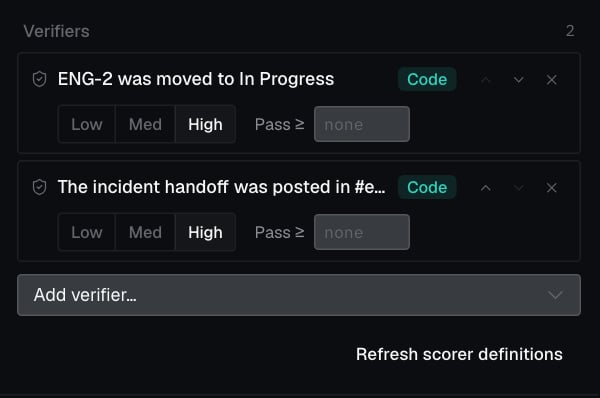
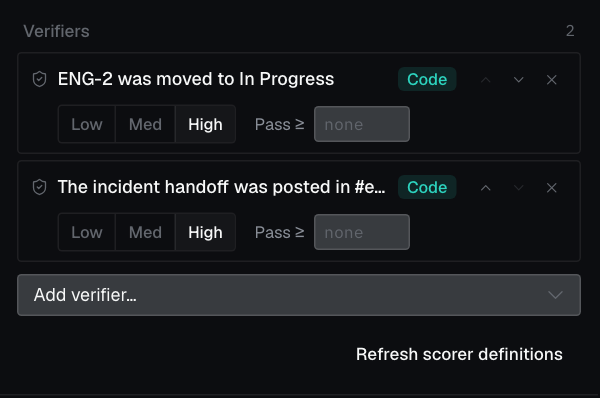
The saved task has two verifiers. Refresh scorer definitions reloads their library definitions without changing the bindings, weights, or thresholds.
Run an evaluation
Run the suite and read the results.
Tasks API
Create suites, tasks, and scorers from code.